Simplifying multi-photon microscopy with stress-less femtosecond lasers
FemtoFiber ultra 1050
Femtosecond fiber laser
In two-photon microscopy, peak-power is brightness! If you care for the best image brightness, you need short pulses, high power, and most importantly a clean temporal pulse shape. The FemtoFiber ultra 1050 features the highest peak power available on the market and hence enables unmatched image brightness.
Additionally, software-controlled dispersion precompensation (GDD) and an integrated AOM for power modulation, make the system extremely user-friendly.
TOPTICA's robust & reliable fiber laser technology significantly reduces the cost of ownership of your laser systems.
The FemtoFiber ultra 1050 is ideally suited for the two-photon excitation of common fluorophores like mCherry, Propidium Iodide, tdTomato, eYFP, DsRed, mRFP or mOrange.
Image Gallery
Your Benefits
Compact & Low cost of ownership
Saving table space with all-integrated robust fiber laser system.
Clean Pulse Technology
TOPTICA’s unique Clean Pulse Technology provides clean, pedestal-free pulses even after the fiber for best image brightness.
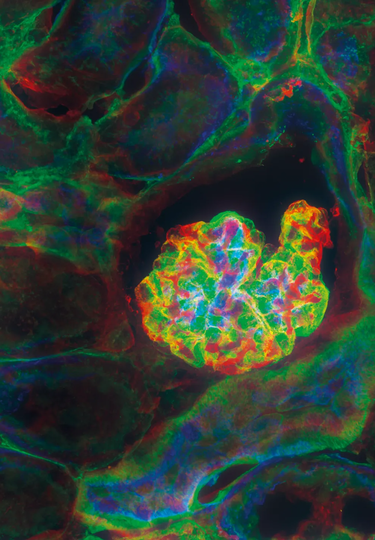
Images by Shau Poh Chong and Peter Török
User-friendly GDD
Short pulses and software-controlled dispersion precompensation (GDD) for user-friendly handling TOPTICA’s FemtoFiber ultra provides motorized group delay dispersion (GDD) pre-compensation that can be controlled in software. Due to chromatic dispersion, a femtosecond pulse stretches in time when transmitted through optical material in the microscope. GDD pre-compensation adds the opposite dispersion to circumvent this effect by cancelling it out. TOPTICA’s software-controllable GDD pre-compensation ensures short pulses at the sample plane with user-friendly, repeatable optimization of fluorescence signal strength via the graphical user-interface (GUI).
Fast power control
An integrated acousto-optic modulator (AOM) enables fast power-modulation and flyback blanking in synchronization with the beam scanner. This minimizes sample damage and photo-bleaching. Also, a fast electronic trigger output is available as reference for TCSPC in FLIM and gated detection.
For all important fluorophores
The FemtoFiber ultra 1050 is ideally suited for the two-photon excitation of common fluorophores like RFP, mCherry, Propidium Iodide, tdTomato, eYFP, DsRed, mOrange, auto-fluorescence or SHG-imaging.
More than 20 years of experience
TOPTICA is drawing upon 20 years of experience in developing OEM-class fiber lasers. We have tailored our FemtoFiber ultra series to provide our customers with an industrial-grade light engine for high-end applications. The reliable and compact laser design provides femtosecond pulses with high average power, excellent temporal and spatial beam quality.
Applications
Neuroscience
High peak power and clean pulse shape are needed for deep-tissue imaging.
Two-Photon microscopy
Two-photon excitation microscopy opens a window deep into living tissue.
Semicon inspection & metrology
Laser-based metrology and inspection have become indispensable tools for shrinking feature sizes, more and thinner layers, as well as increasing chip and package areas.
Two photon polymerization (3D microprinting)
TOPTICA’s ultrafast laser platforms provide the pulse duration, repetition rate, and spatial coherence essential for high throughput and ultimate structural fidelity in 3D laser lithography.
Options
AOM
Integrated AOM for fast modulation of the laser light, integrated to the system.
Pulse picker
An integrated pulse picker reduces the effective repetition rate from 80 MHz to 8 MHz (1:10).
Custom repetition rate
The custom repetition rate provides a modified oscillator with a pre-defined repetition rate between 40 and 80 MHz upon ordering.
Dual-color
With the FemtoFiber ultra dual-color option two FemtoFiber ultra are optically synchronized and allow simultaneous imaging with two different laser colors.
No laser wavelength tuning is required.
FemtoFiber ultra 525
The system has an additional SHG unit that can generate femtosecond pulses with an average power of > 0.5 or > 1 W at 525 nm.
The FemtoFiber ultra is a very powerful laser system that exceeded our requirements. We never maxed out the capabilities of the laser system.
Prof. Dr. Jörg Enderlein
Georg-August-Universität Göttingen, III. Physikalisches Institut, Germany
As an independent neuroscience microscope integrator INSS has installed numerous multi-photon systems around the globe. We integrated many TOPTICA FemtoFiber ultra lasers in different configurations. FemtoFiber ultra 920 is a rock-solid solution for two-photon excitation of GCaMP and other fluorescent protein.