Simplifying multi-photon microscopy with stress-less femtosecond lasers
FemtoFiber ultra 920
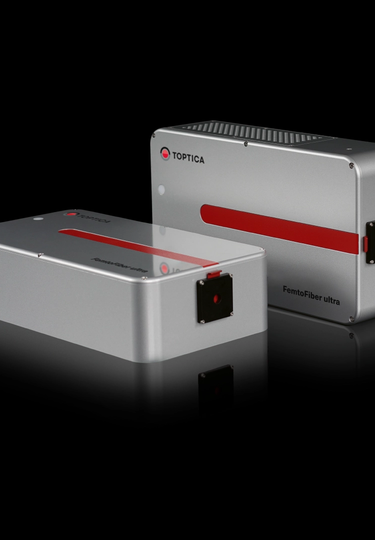
Femtosecond fiber laser
For the best image brightness, you need short pulses, high power and, most importantly, a clean temporal pulse shape – and that's where we come in!
With our unique Clean Pulse Technology, the FemtoFiber ultra 920 femtosecond fiber laser delivers outstanding brightness in two-photon microscopy while keeping unwanted heating of the sample low. It is a compact, turn-key fiber laser alternative to Ti:Sapphire lasers, it ticks every box.
In addition, software-controlled dispersion precompensation (GDD) and an integrated AOM for power modulation make the system intuitive and easy to use, so you can stay focused on your work.
Our robust and reliable fiber laser technology helps reduce the overall cost of ownership. At the same time, the quiet and compact design minimizes noise stress for animals and saves valuable table space.
The FemtoFiber ultra at 920 nm is absolutely perfect for multiphoton microscopy with common fluorophores such as GFP, eGFP, Eosin, GCaMP, CFP, Calcein, and Venus.
Image Gallery
YouTube Video
To view this video, please accept YouTube cookies in your privacy settings.
Your Benefits
Compact & Low cost of ownership
Saving table space with all-integrated robust fiber laser system.
Clean Pulse Technology
TOPTICA’s unique Clean Pulse Technology provides clean, pedestal-free pulses even after the fiber for best image brightness.
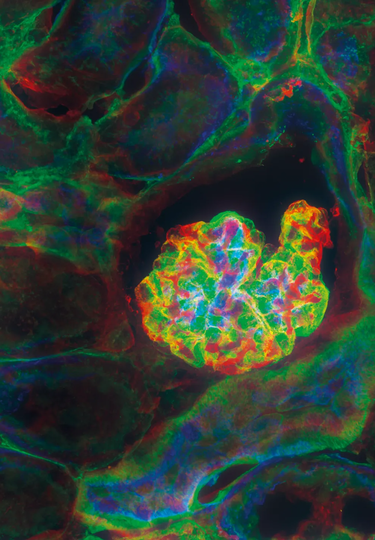
Images by Shau Poh Chong and Peter Török
User-friendly GDD
Short pulses and software-controlled dispersion precompensation (GDD) for user-friendly handling. TOPTICA’s FemtoFiber ultra provides motorized group delay dispersion (GDD) pre-compensation that can be controlled in software.
Fast power control
An integrated acousto-optic modulator (AOM) enables fast power-modulation and flyback blanking in synchronization with the beam scanner. This minimizes sample damage and photo-bleaching. Also, a fast electronic trigger output is available as reference for TCSPC in FLIM and gated detection.
For all important fluorophores
The FemtoFiber ultra 920 is ideally suited for the two-photon excitation of common fluorophores like GFP, eGFP, Eosin, GCaMP, CFP, Calcein or Venus.
More than 20 years of experience
With 20 years of experience developing OEM-class fiber lasers, TOPTICA is a leader in the field. We have tailored our FemtoFiber ultra series to provide customers with an industrial-grade light engine for high-end applications. Unlike bulky, alignment-sensitive Ti:Sapphire or OPO systems, TOPTICA's femtosecond fiber lasers are reliable and compact. They provide femtosecond pulses with high average power and excellent temporal and spatial beam quality.
Applications
Neuroscience
High peak power and clean pulse shape are needed for deep-tissue imaging.
Two-Photon microscopy
Two-photon excitation microscopy opens a window deep into living tissue.
Label free & clinical imaging
Label-free imaging visualizes chemical and structural information in living cells without stains or labels.
Options
AOM
An AOM for fast modulation of the laser light can be integrated into the system. Ready to use. No complicated optics taking up valuable table space.
Pulse picker
An integrated pulse picker reduces the effective repetition rate from 80 MHz to 8 MHz (1:10).
Custom repetition rate
The custom repetition rate provides a modified oscillator with a pre-defined repetition rate between 40 and 80 MHz upon ordering.
Dual-color
With the FemtoFiber ultra dual-color option two FemtoFiber ultra are optically synchronized and allow simultaneous imaging with two different laser colors.
No laser wavelength tuning is required.
FemtoFiber ultra 460
The system has an additional SHG unit that can generate femtosecond pulses with an average power of >0.1 W at 460 nm.
Fiber delivery
Replace the free-space path between the femtosecond laser and the two-photon microscope. Our product FemtoFiber ultra FD delivers its pulses via a polarization-maintaining hollow-core fiber.
Specifications
The FemtoFiber ultra is a very powerful laser system that exceeded our requirements. We never maxed out the capabilities of the laser system.
Prof. Dr. Jörg Enderlein
Georg-August-Universität Göttingen, III. Physikalisches Institut, Germany
As an independent neuroscience microscope integrator INSS has installed numerous multi-photon systems around the globe. We integrated many TOPTICA FemtoFiber ultra lasers in different configurations. FemtoFiber ultra 920 is a rock-solid solution for two-photon excitation of GCaMP and other fluorescent protein.
Bruno Pichler, Ph.D.
Founder INSS
I chose the FemtoFiber ultra 920 due to its short pulse, compact design, and high power which is sufficient for two systems. So it's great, the performance is as promised, the laser is very stable and the beam profile is exceptionally clean. Highly recommended!
Prof. Yoav Adam
The Hebrew University, Israel
The inherent stability, the ease of use, and the clean temporal pulse shape of the FemtoFiber ultra 920 make TOPTICA‘s fiber lasers the ideal choice for our applications in neuroscience.
Zhou Zhenqiao, Ph.D.
Suzhou Institute of Biomedical Engineeering and Technology (SIBET), China
I recommend the FemtoFiber ultra 920 and FemtoFiber ultra 1050 to other colleagues because both are reliable, easy to use, plug and play, with specifications that perfectly fit our purpose, no vibration on the optical table, no chiller noise, and last but not least because of the great support from TOPTICA.
Vajda F, Szepesi Á, Erdei Z, Szabó E, Várady G, Kiss D, Héja L, Német K, Szakács G, Füredi A., Stem Cells Increase Drug Tolerance of A431 Cells Only in 3D Spheroids, Not in 2D Co-Cultures, Int. J. Mol. Sci. 2024, 25, 4515
Márton Péter, László Héja, High-Frequency Imaging Reveals Synchronised Delta- and Theta-Band Ca2+ Oscillations in the Astrocytic Soma In Vivo, nt. J. Mol. Sci. 2024, 25(16), 8911
Robert M. Lees, Bruno Pichler, Adam M. Packer, Contribution of optical resolution to the spatial precision of two-photon optogenetic photostimulation in vivo, Neurophotonics, Vol. 11, Issue 1, 015006 (Feb 2024)